
Some days just click.
Ascenda Flow shows you
what was different.
The history is already on this Mac.
Cursor · VS Code · Claude Code · Codex · local AI
Your agents keep a record. You've never read it.
Claude Code, Cursor and Codex have been keeping a history on this Mac. Flow reads it back in under a minute, like a year in review on day one: your busiest hours, your longest sessions, how many agents you had going at once. No account. Nothing uploaded.
Your tools forget. Flow remembers.
Claude Code deletes its own history after 30 days by default. You can check that on your own machine. Flow’s import preserves what’s still there.
The import is a button.
No terminal, no scripts, no account. Pick your tools and press it. The import writes what it found to your disk first, where you can read it.
Then a few named days.
The record already has the week. The walk is at most five days, so what is flow for you is named by you, not inferred. “I don’t remember” is always an answer.
The work record carries the load. A few named answers make the pattern yours.
Tuesday worked. Thursday didn't. This is the difference, written down.
Four examples of what Flow reads from history that is already on the machine. Illustrative, not anyone's real data. The ones you get name days you actually had. Your week has a shape.
Your best work happens before 11am.
Your longest uninterrupted blocks land between 8:30 and 10:45, three days out of five. Meetings after 11 fragment what is left of the morning.
Two meetings, and the afternoon changes shape.
After back-to-back calls, tool switching climbs and focus blocks get shorter. The return to deep work takes longer than it feels like it should.
Tuesday wasn't a fluke.
Your strongest days share a shape: fewer interruptions, longer AI sessions, meetings pushed past 11. Thursday had none of it.
Your biggest days borrow from the morning after.
On the days you run the most agents at once, the next morning opens with three to four hours of rework before anything new starts.
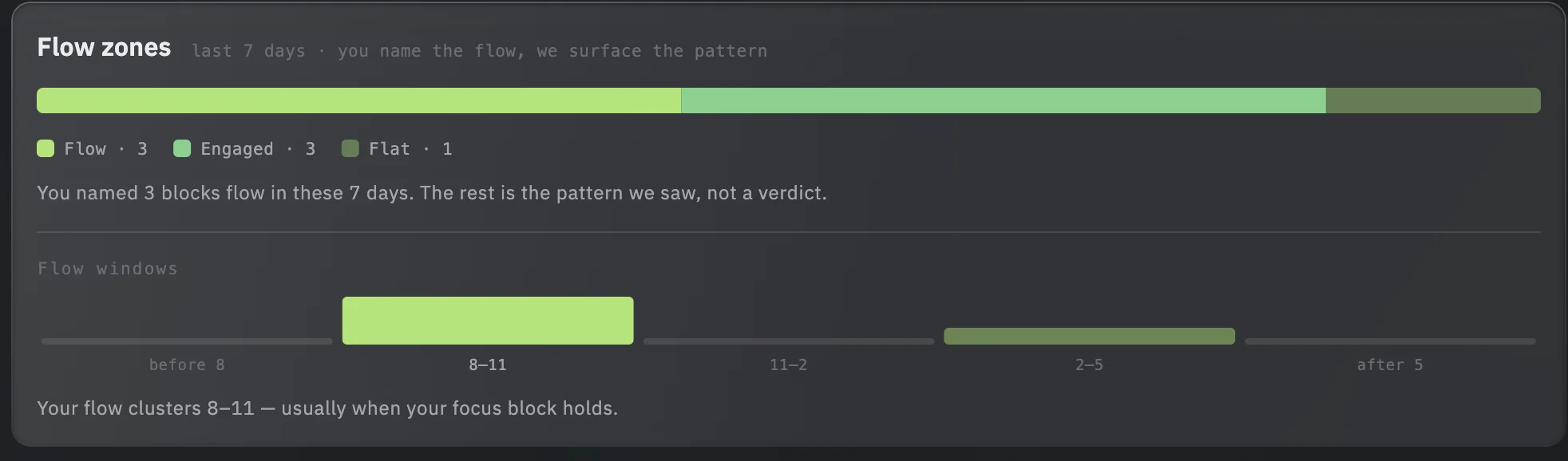
What would Flow read in your week?
This is the product. Not a render of it.
Twelve weeks of work-pattern data, straight off the machine. Cursor, VS Code, Claude Code, Codex, terminal, browser, meetings. The whole scattered day, in one place.
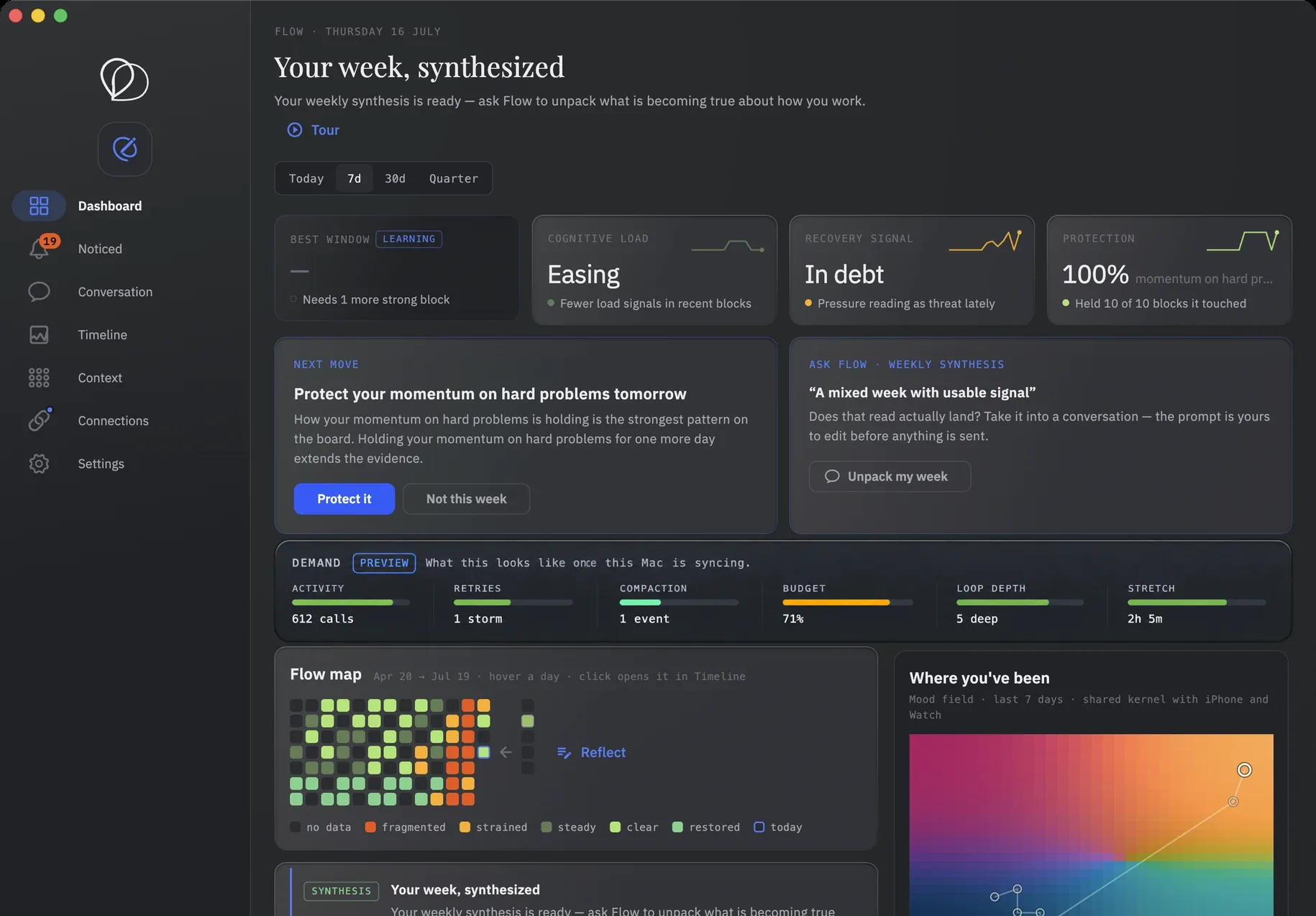
See the shape of a day
When uninterrupted deep work actually happens, and how long it lasts before friction sets in. Locked-in hours, made visible.
Protect the block
How often messages, meetings, and tool switches break a session. Name the interruption cost, then decide what to protect next week.
Name the flow
Time in Flow, Engaged, Strained, and Flat. You name them in your check-ins; Flow surfaces the pattern.
It watches the load while you work.
The record does not stop at import. Every other view describes a window you chose. One card describes a run of days the record picked out itself, on the grounds that it holds no precedent for it.
These 12 days are unlike anything in your record.
Since 14 August your days have carried about twice the demand of your middle day. Across the 180 days on record, no other 12 carry as much.
The record kept running. The thing you said is still there.
The agents take the hours. They take the clock with them. Flow does not bring you back to yourself. It keeps the day you were not available to watch, and the constraint you set before you disappeared.

Arm it and walk off.
The bell tells you when the agents are done. “Is it finished yet” stops being a decision.
Did you lose track of time?
One tap. You name the flow.
You decide once.
Protect the morning. Stop before seven. Flow holds the constraint so you don’t renegotiate it mid-run.
Make one change. See if it held.
Protect the morning. Batch the reviews. Run fewer agents at once. Stop earlier. Flow remembers what you changed and puts the next week beside the last one. No score to raise. No streak to keep alive. Just your record.
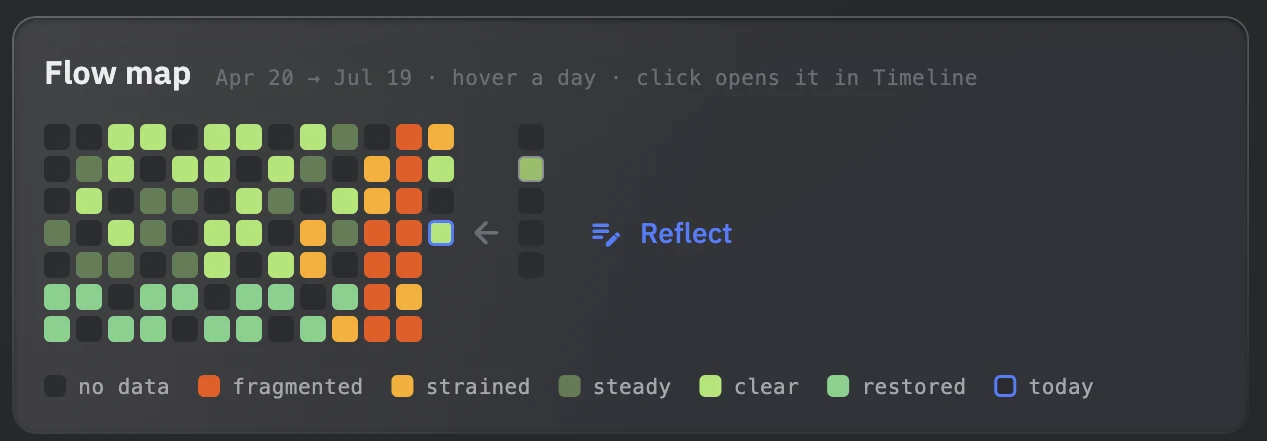
When am I at my best?
Which hours hold, and which ones never do. Zones and windows sharpen from your own check-ins and the demand your tools emit, until your week has a shape you can point at.
What knocks me out of it?
Interruptions, meetings, tool switching, and the AI loops that ran three rounds longer than they needed to. Counted, and placed on the day they happened.
What did I decide?
Protect a morning. Batch the calls. Stop earlier. One constraint, chosen by you. Flow holds it. It does not hand you a new plan every Monday.
Did it actually hold?
The weeks before, and the weeks after. No grade. No streak. The next week sits beside the last one, against your own record rather than a benchmark.
The read stays on this Mac. You can check.
The import is a local read. Nothing from that pass is uploaded. Your journal and reflections stay on this Mac unless you turn on sync. What leaves by default is operational shape: counts, timings, tool events. Never your words. There is no employer access to any individual: structurally absent, not restricted.
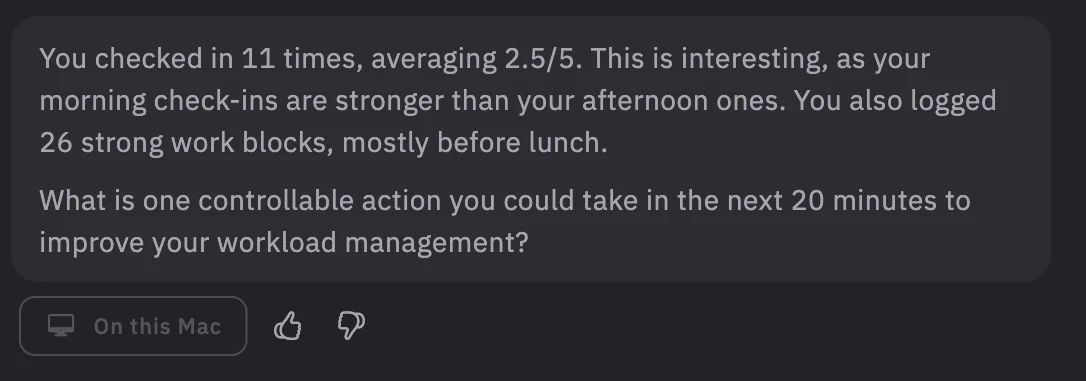

Don't take this page's word for any of it. Proxy Flow's traffic and compare it against the published shape; watch the import run and read what it wrote to your own disk. Both checks, and the rest, are written out on the data page.
You've never felt better at work. You've never made this many decisions in a day.
That is not a crisis. The work got better, and denser. You write less by hand. You steer more. Review more. Choose more. Sometimes you run several pieces at once. The work changed faster than the instruments for understanding it.
AI is addictive. One more prompt, one more agent. But it's a different kind of load from coding in flow, and the models change how they behave every few weeks. We're all experimenting with the same things, and no one is really tracking what works.
Flow is an instrument for the person running the agents. It reads the demand the work already emits. It never claims to read how you feel.
84% OF AI-ASSISTED ENGINEERS REPORT PRODUCTIVITY GAINS. IN THE SAME SIX MONTHS, THE SHARE REPORTING A WORSE WORKING EXPERIENCE DOUBLED FROM 14% TO 27%.
Vella & Blincoe · longitudinal study
THE WORK GOT BETTER. AND DENSER. LESS TYPING BY HAND. MORE STEERING, REVIEWING, CHOOSING. SOMETIMES SEVERAL PIECES AT ONCE. NONE OF THAT SHAPE SHOWS UP IN A COMMIT LOG.
The job, as it actually runs
DEVELOPERS USING AI TOOK 19% LONGER WHILE BELIEVING THEY WERE 20% FASTER.
METR · Cursor RCT, 2025
Three kinds of instrument watch people work.
Each one makes a different claim about you. Only one of them is checkable.
Wellness apps
“We know how you feel.”
A claim nobody can verify, wearing a daily score. This audience already left over it.
Bossware
“We know what you did.”
Output measured in exquisite detail — for someone else. The folk memory is a manager reading your dashboard back to you.
Ascenda Flow
“We know what the work demanded. How it felt is yours to say.”
An instrument for the person running the agents. The demand of the work is measurable.
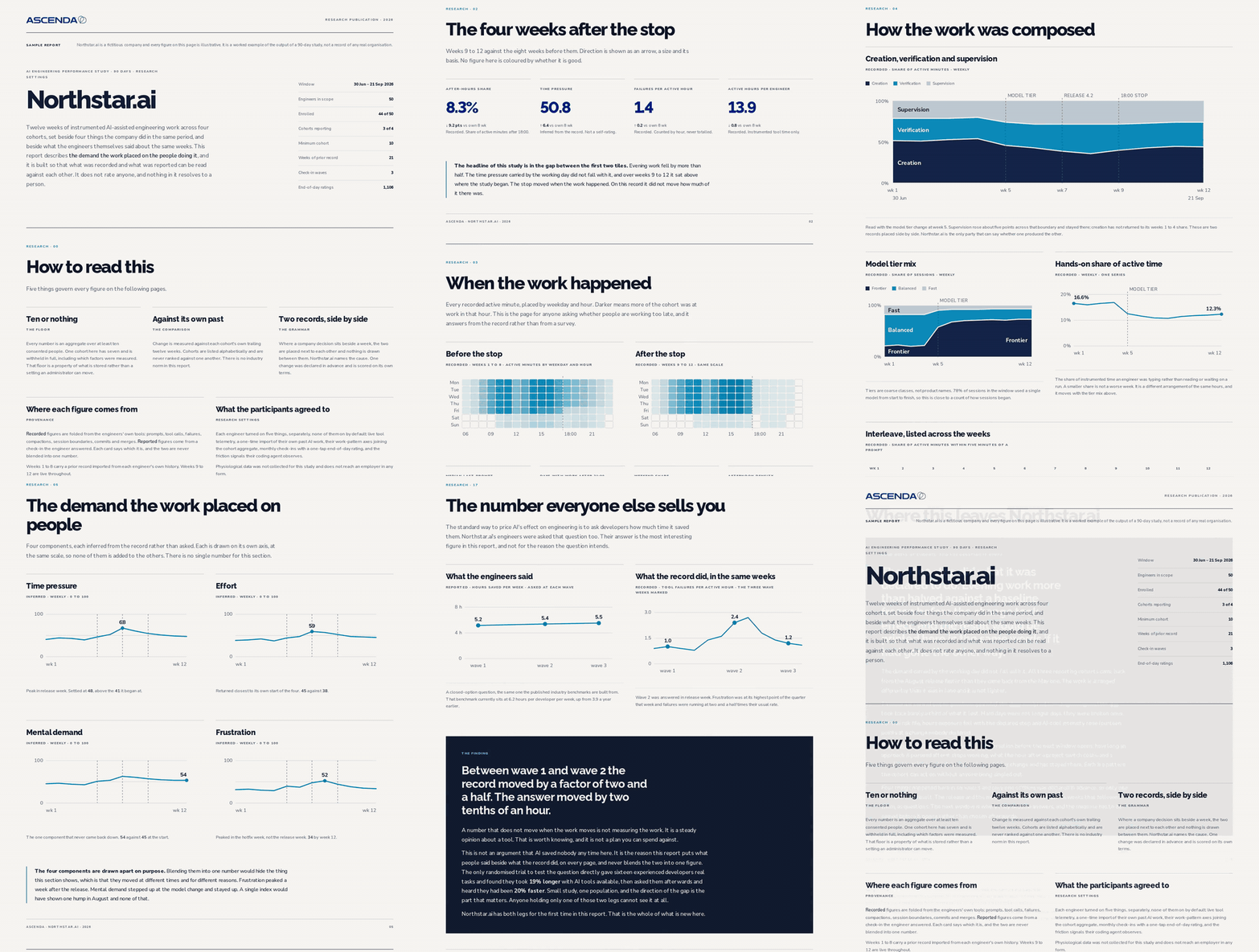
The company does not see you. It sees what the work demanded.
That is the checkable claim, written as a publication. Not a dashboard of people. A page a buyer can hold, with the rules printed on it.
Ten or nothing
Every figure is an aggregate over at least ten. A smaller cohort is withheld in full.
Against its own past
A cohort is compared with its own earlier weeks. Never with another cohort.
Nothing names a person
What the work demanded sits beside what people reported. The two are not blended, and neither resolves to anyone.
ascenda.one
Your questions, answered directly
Read the record you already have
Point Flow at the stores your agents already wrote. No account. The complete local product stays on this Mac.